This piece answers "which Indian states have the worst school infrastructure right now" using TOI ground reporting plus official UDISE 2025–26 data.
Rajasthan tops the list with 3,768 dilapidated school buildings, 2,047 schools with no toilets, and the Jhalawar roof collapse that killed seven children, alongside Bihar (schools sharing compounds with livestock), and structural decay in Uttarakhand, Madhya Pradesh, and Chhattisgarh.
The core insight: Rajasthan is India's 2nd-highest CSR recipient nationally, yet still has one of the worst infrastructure crises, proving funding alone doesn't fix schools.
Bihar shows the opposite problem: genuinely underfunded, absent from the top-10 CSR list entirely.
Which Indian States Have the Worst School Infrastructure Right Now?
Based on recent ground reporting and government data, Rajasthan, Bihar, Uttarakhand, Madhya Pradesh, and Chhattisgarh currently show the most severe gaps in basic government school infrastructure. Missing toilets, no drinking water, collapsing buildings, and in some cases, animals sharing the school compound with children.
Interestingly, some of these states, like Rajasthan, actually receive some of the highest CSR funding in the country, which raises a bigger question this article will get into: is money really the problem, or is it where that money goes?
If you've seen the recent Times of India ground report on Rajasthan's schools or the follow-up piece on schools across other states, you already know this isn't a small problem.
Let's break down exactly which states are struggling the most, why, and what's actually being done about it.
What Do We Mean by "School Infrastructure"?
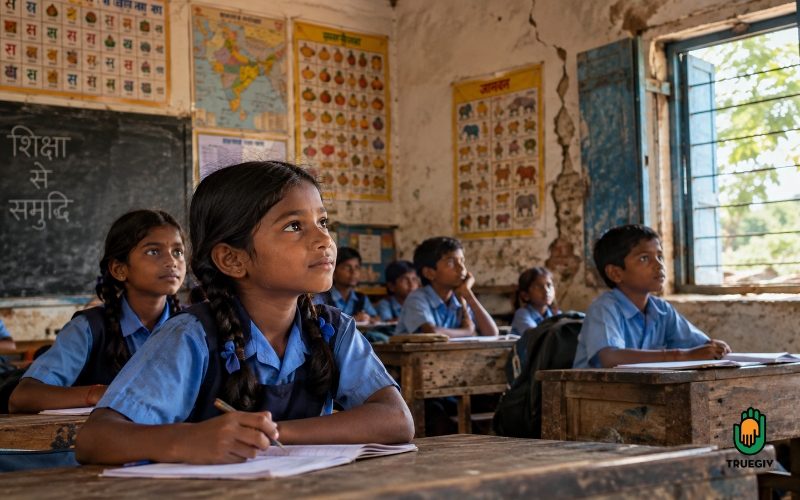
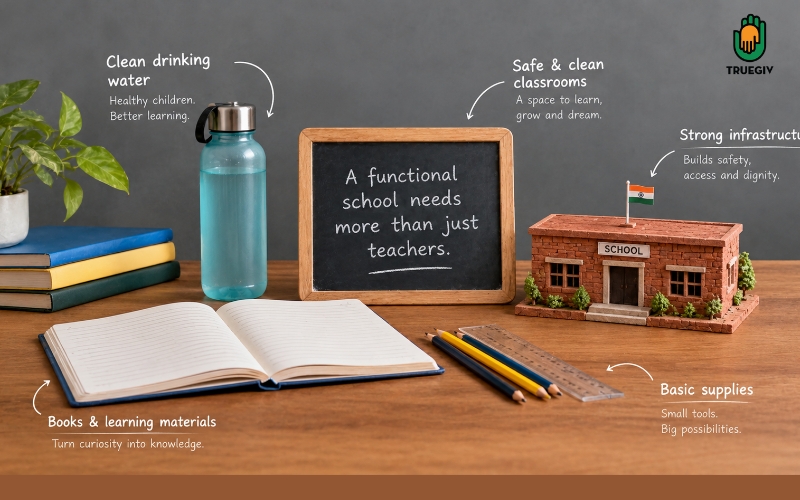
Before ranking anything, it helps to be clear about what we're actually measuring. "School infrastructure" isn't a vague policy term, it's a short list of very physical things:
- A building that's structurally safe, with a roof that won't collapse
- Toilets, separate for girls and boys, that actually work
- A safe source of drinking water
- Enough classrooms so multiple grades aren't crammed into one room
- Enough teachers so a single person isn't handling five grades at once
- Basic furniture like desks and benches, so children aren't sitting on bare floors
This is the floor, not the ceiling, of what a government school needs. And right now, several states are struggling to provide even this.
Which State Has the Worst School Infrastructure in India Right Now?
Based on the most recent ground reporting, Rajasthan currently has the most documented, severe school infrastructure crisis in the country and the numbers are stark.
In July 2025, a school roof collapsed in Piplodi village, Jhalawar district, killing seven children and injuring nearly 30 others while they gathered for morning assembly. It wasn't an isolated freak accident.
According to the TOI investigation across six Rajasthan districts, citing official UDISE 2025–26 data:
- 611 government schools in Rajasthan have no building of their own, including 10 girls' schools
- 3,768 school buildings and 83,783 classrooms are officially classified as completely dilapidated
- 2,047 schools have no toilets at all
- 1,049 schools have no drinking water facility
- 7,200 schools run on a single teacher
- Over 1.5 lakh teaching posts sit vacant across the state
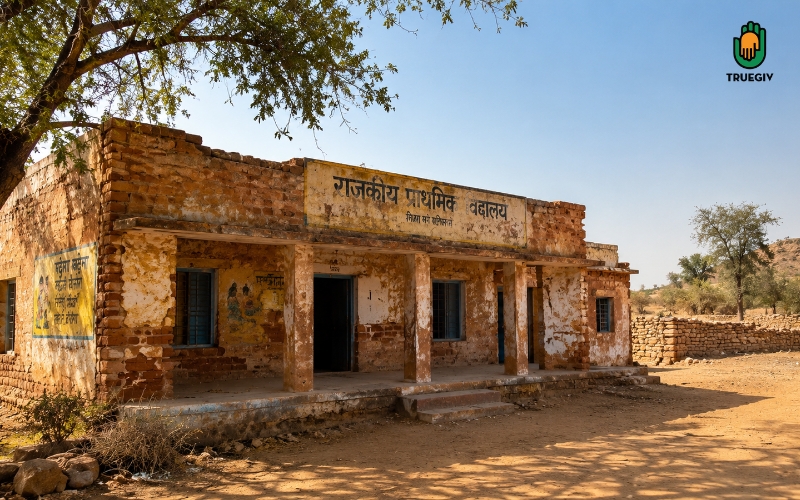
In Kota district alone, 61 school buildings have been declared completely ruined by the Public Works Department and marked for demolition. In the Chief Minister's own Sanganer constituency, 404 students across 12 grades are squeezed into just four usable rooms because another wing was declared unsafe.
In one Kota primary school, 78 children attend classes out of municipal parking kiosks and tin sheds. On full-attendance days, children in several schools sit under trees or in open verandas because there simply isn't classroom space.
Following the public pushback after these reports, the Rajasthan government pledged a ₹12,000 crore roadmap over three years to repair and rebuild school infrastructure across the state, a significant commitment, and one worth tracking closely to see how it's actually spent.
What's Happening in Bihar's Government Schools?
Bihar's problems look different, but they're just as serious. According to the TOI ground report from Rohtas and Doiya, some schools are functioning directly inside what are effectively cattle compounds with buffaloes and livestock tethered inside the school premises. Children have to walk through mud, slush, and cattle troughs just to reach their classrooms.
This isn't a story about one unlucky school. It reflects a broader, well-documented pattern of underinvestment in Bihar's rural school infrastructure, where basic separation between a functioning school campus and everyday village life has broken down entirely in some areas.
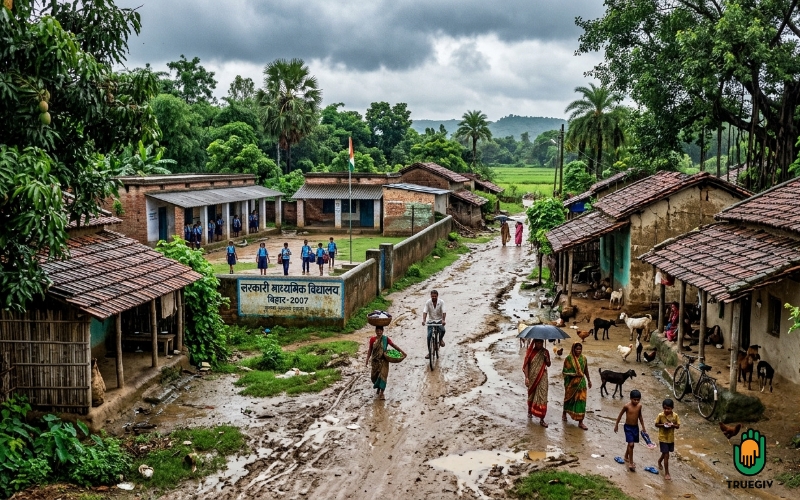
Uttarakhand, Madhya Pradesh, and Chhattisgarh: Same Crisis, Different Terrain
The same TOI ground report documented similar patterns of decay across three more states, each with its own specific problems:
- Uttarakhand: At the Government Inter College in Kapkot (Bageshwar district), peeling plaster and water dampness have spread across the walls. In Pangot, eight schools are officially classified as completely dilapidated with broken masonry, exposed electrical wiring, and wooden supports literally propping up collapsing structures.
- Madhya Pradesh: In Bhaironpura, classrooms have deep structural wall cracks while children sit on bare floors beneath ceiling plaster that's actively falling. In Kolar (Bhopal), 70 students share a single crumbling room with one teacher, and they're regularly forced outdoors for safety. In Jabalpur, the staffing shortage has grown serious enough that students have staged protests under banners reading "No teacher, no education."
- Chhattisgarh: In Bilaspur, several schools are running out of makeshift huts and decaying brick structures, with damaged walls, improvised entrances, and overgrown debris around the buildings.
Interestingly, Madhya Pradesh and Chhattisgarh both rank among the better-performing states for one specific metric: functional toilets, where both cross 98%.
This is a useful reminder that infrastructure problems aren't one uniform crisis. A state can be doing reasonably well on one basic need and still be failing badly on others, like safe buildings or teacher staffing.
Does More CSR Money Actually Mean Better Schools?
This is where the story gets genuinely surprising and it's the most important question this data raises.
You'd assume the states with the worst school infrastructure are also the states receiving the least corporate funding. That's only partly true.
According to CSR spending data reported by Business Today, Rajasthan was the second-highest recipient of CSR funds in India in FY 2023-24, behind only Maharashtra, and ahead of Tamil Nadu, Gujarat, and every other state in the country. Chhattisgarh also made the top 10 list nationally.
In other words, the money has, at least on paper, been flowing into some of these exact states.
Bihar tells the opposite story. Despite its documented crisis, Bihar doesn't appear anywhere in the national top 10 CSR-recipient list. And a government-cited analysis found that India's "aspirational districts", a category that includes large parts of Jharkhand, Chhattisgarh, Bihar, Odisha, and Madhya Pradesh collectively receive less than 20% of the total national CSR pool, even though these are precisely the districts that need it most.
A separate breakdown from Sattva Consulting shows that among aspirational districts specifically, Madhya Pradesh gets 9.8% and Chhattisgarh 6.5% of that already-small pool, meaning Bihar, one of the worst-affected states, gets an even thinner slice.
So the honest answer is: money alone doesn't fix this. Rajasthan is proof that a state can receive serious CSR funding and still have 3,768 dilapidated school buildings.
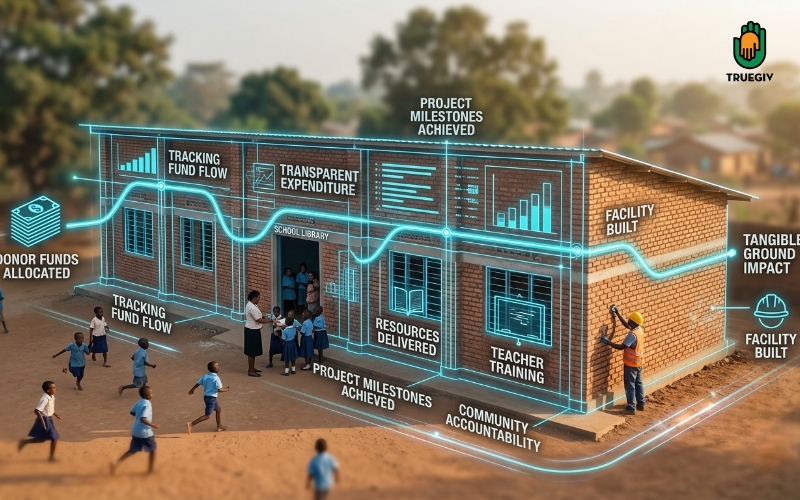
The real gap isn't just funding, it's whether that funding is tracked all the way to a specific school, a specific classroom, and a specific child, with proof that it actually got there.
So Which States Need Help Most Right Now?
Putting the infrastructure data and the CSR data side by side gives a clearer picture than either one alone:
|
State
|
Core problem (from ground reports)
|
CSR funding position
|
|
Rajasthan
|
Building collapses, 3,768 dilapidated buildings, 2,047 schools with no toilets
|
High (2nd highest in India) but clearly not translating into fixed buildings
|
|
Bihar
|
Livestock inside school compounds, severe underinvestment
|
Not in the national top 10 badly underfunded relative to need
|
|
Uttarakhand
|
Structural decay, exposed wiring, collapsing masonry
|
Moderate. Receives a small share even among aspirational-district funding
|
|
Madhya Pradesh
|
Wall cracks, staff shortages, student protests
|
Better toilet infrastructure, but still short on buildings and teachers
|
|
Chattisgarh
|
Makeshift huts, decaying structures
|
In the national top 10 for CSR, yet still short on classroom buildings
|
Two different problems are visible here, and they need two different fixes.
Bihar needs more money to reach it in the first place.
Rajasthan and Chhattisgarh need the money that's already arriving to be tracked, verified, and followed through to an actual finished classroom, not just an approved budget line.
What Can Actually Be Done About This?
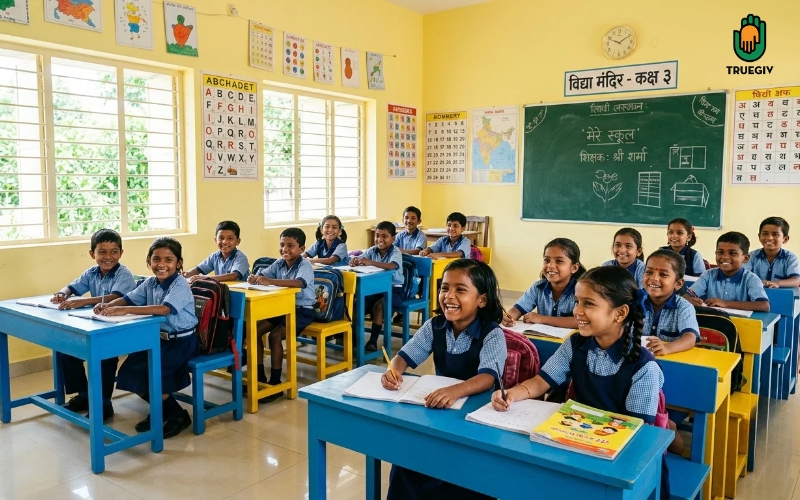
None of the individual problems in this data are complicated to fix. A missing toilet, a broken bench, a blackboard that's really just a painted wall, a school with no fan or lights. These are all solvable at the level of a single school, without waiting for a new national policy.
What's harder is making sure the money meant for these fixes actually becomes the fix, not a report, not a budget approval, not a half-finished project that stalls. That's the specific gap organisations like TrueGiv are built to close: every school project is verified on the ground before it's even listed, every delivery is geotagged, and every donor, individual or corporate, gets proof of exactly where their contribution went, down to an invoice and, if they want it, a video call with the school itself.
Rajasthan, Bihar, Uttarakhand, Madhya Pradesh, and Chhattisgarh are currently the states with the most visible, documented school infrastructure crises in India, and the reasons differ from state to state. Some lack funding entirely, others have funding that isn't reaching the ground.
What's common across all of them is a simple truth: a child can't focus on learning when they're worried about a roof, a toilet, or where to get a drink of water.
The scale of the problem is national. The fix, every time, is local. One verified school, one verified classroom, one child who now has the basics they need to actually stay in school.
FAQs
1. Which Indian state has the worst school infrastructure right now?
Based on recent ground reporting and official UDISE 2025–26 data, Rajasthan currently has the most severe documented school infrastructure crisis in India. 3,768 school buildings and 83,783 classrooms classified as completely dilapidated, 2,047 schools with no toilets, and 611 schools with no building of their own.
2. How many government schools in India don't have toilets or drinking water?
In Rajasthan alone, 2,047 schools have no toilets and 1,049 have no drinking water facility, according to UDISE 2025–26 data.
Nationally, earlier UDISE+ figures showed close to 99,000 schools without a functional girls' toilet and over 61,500 schools with no usable toilet at all.
3. Which state in India receives the most CSR funding?
Maharashtra receives the highest CSR funding in India, followed closely by Rajasthan and Tamil Nadu. The top 10 states together account for roughly 60% of all CSR spending nationally, leaving the remaining states to share a much smaller pool.
4. Does more CSR funding actually fix bad school infrastructure?
Not automatically. Rajasthan is the second-highest CSR recipient in India, yet still has one of the worst documented infrastructure crises in the country.
This shows that funding alone isn't the bottleneck. Tracking whether that funding actually reaches a specific school, in a verifiable way, is what determines real impact.
5. What is UDISE+ and why is it used as a data source?
UDISE+ (Unified District Information System for Education Plus) is the Indian government's own school data collection system, run by the Ministry of Education. It's the largest school infrastructure survey in the world and the primary source behind most official statistics on Indian school conditions, including recent investigative reporting by Times of India.