Overview
While India's school infrastructure has expanded significantly over the past decade, critical gaps persist across thousands of classrooms. National averages mask severe regional disparities in basic amenities like electricity, functional toilets, and drinking water. Closing this execution gap requires transparent, verifiable, asset-tracked giving that directly connects donor capital to measurable classroom infrastructure.
The State of School Infrastructure in India: What the Latest Data Really Shows
Every year, more than 24 crore children walk into a school somewhere in India. That's more people than the entire population of most countries in the world, all sitting inside one school system.
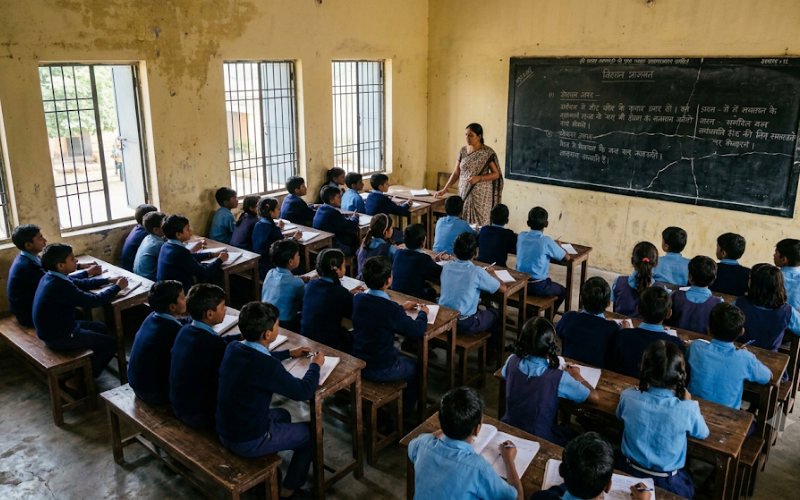
But walking into a school and getting a real education inside it are two different things. Behind every enrolment number is a simpler, more basic question: does that school actually have what a child needs to sit, learn, and stay healthy through the day? A working toilet. Clean drinking water. Electricity. A desk. A blackboard that isn't cracked down the middle.
The good news is that India has made real progress on this front over the last ten years. The harder truth is that the progress is uneven, and for lakhs of children, the basics are still missing. This piece walks through what the latest government data actually shows, why young Indians have started paying closer attention to this issue, and what it means for anyone looking for the best NGOs in India for donation to make a direct impact.
What Do We Actually Mean by "School Infrastructure"?
When people say "school infrastructure," it can sound like a vague, official term. In reality, it means very ordinary, physical things:
- A functional toilet, separate for girls and boys
- Safe drinking water that actually works, not just a tap that was installed once
- Electricity that runs through the day, not just on paper
- Enough classrooms so children aren't taught three grades in one room
- Basic furniture like desks and benches so children aren't writing on the floor
- Ramps and rails for children with disabilities
- Boundary walls, playgrounds, and kitchens for the mid-day meal
None of this is advanced. It's the floor, not the ceiling, of what a school needs. And it's exactly what India's own government tracks every year through a system called UDISE+ (Unified District Information System for Education Plus), the largest school data collection exercise in the world, run by the Ministry of Education.
The Good News First: India Has Made Real Progress
It's worth starting with what has actually improved, because the progress is genuine.
According to UDISE+ data cited in a 2026 NITI Aayog report, the share of schools with electricity rose from 55.96% in 2014 to 91.9% in 2024-25. That's a massive jump in a decade, roughly four out of ten schools gained power that didn't have it before.
Drinking water and toilets tell a similar story. The Ministry of Education's UDISE+ 2023-24 report shows that 98.3% of schools now have drinking water facilities and 97.2% have separate girls' toilets. A decade ago, these numbers were nowhere close to this.
This matters, and it's important to say so plainly. A lot of hard, unglamorous government work went into this like laying pipes, running wires, building toilet blocks in villages that didn't have proper roads leading to them.
But the National Average Hides a Harder Story
Here's where it gets more complicated. National percentages look reassuring, but they average away entire states, and entire kinds of schools, that are still struggling.
A few numbers from the same UDISE+ 2023-24 data, reported by iDream Education:
- Nearly 1.52 lakh schools in India still don't have functional electricity, out of 14.71 lakh total schools.
- Only 50% of all schools have access to computers for teaching.
- Among government schools, only 33.2% have disabled-friendly toilets, and just 30.6% of those are actually working.
The 2024-25 numbers, cited by NITI Aayog, add more detail:
- 98,592 schools still lack a functional girls' toilet.
- 61,540 schools have no usable toilet of any kind.
- 14,505 schools have no functional water source.
- 59,829 schools have no handwashing facility at all.
- Nearly half of government secondary schools still don't have a working science lab.
- India still has 1,04,125 single-teacher schools, where one person teaches every grade, handles the mid-day meal, and does all the paperwork.
Think about what that means for a single child. A "functional toilet" isn't a checkbox, it's the difference between a girl staying in school through her teenage years or dropping out.
A "functional water source" isn't a line item, it's whether a child can drink safely on a 40-degree afternoon in May.
The Digital Divide Hiding Behind the Basics
There's a second layer to this problem that often gets missed, because it sits one level above toilets and electricity: computers and internet access.
The same 2024-25 data shows internet connectivity in schools rising to 63.5%, up from 53.9% the year before. But that also means well over a third of India's schools still have no internet at all. Around 5 lakh schools, roughly one in three, still lack computers or internet access altogether, and the gap is worse in rural areas, which make up about 70% of all schools and lag urban schools by 10 to 15 percentage points on digital access.
This matters because digital access has quietly become a basic skill, not an advanced one. A child who never touches a computer in school isn't just missing out on "extra" learning, they're starting several steps behind in almost every field they might enter later, from clerical jobs to engineering colleges that assume basic computer familiarity on day one.
It's also a reminder that "infrastructure" doesn't stop at the physical building. A school can have electricity and a toilet and still be unable to give its students a single hour of hands-on computer time in an entire year.
Why This Isn't Just About Comfort
It's easy to hear numbers like "1.52 lakh schools lack electricity" and file it under "unfortunate, but not urgent." It's worth being specific about why that reaction is wrong.
A school without a functional toilet doesn't just make the day less pleasant, it's one of the most well-documented reasons girls drop out once they reach their teenage years.
A school without safe drinking water means children either go thirsty through a school day that can run six hours or more, or drink from a source that isn't properly maintained.
A single-teacher school, of which India still has over a lakh, means a ten-year-old and a fourteen-year-old are often sitting in the same room, being taught by the same person at the same time, because there simply isn't another teacher or another classroom.
None of these are side issues to "real" education. They are the conditions that decide whether a child stays in school long enough for the curriculum to matter at all.
Why the Gap Between States Is So Wide
The national picture also hides just how differently states are doing. EducationWorld's analysis of the UDISE+ 2023-24 data breaks this down clearly using India's two most populous states as an example.
In Uttar Pradesh, out of 2,55,087 schools, only 33.7% have functional computers, and 39,012 schools still don't have working electricity. In Bihar, out of 94,686 schools, only 18% have functional computers, and 45,836 schools, nearly half, lack functional electricity.
Compare that to states like Madhya Pradesh and Chhattisgarh, which rank among the best in the country for toilet facilities, with over 98% of schools having functional toilets.
This is the real shape of the problem. It isn't that India, as a country, hasn't tried. It's that the improvement hasn't reached every state, every district, and every village school at the same pace.
A New Kind of Attention: Young Indians Are Asking Sharper Questions
Something else has changed recently, and it's worth naming honestly: young Indians are paying closer attention to the state of government schools than they have in years.
Over the past year, small groups of young volunteers in several states have started visiting government schools on their own, documenting missing benches, broken toilets, and school buildings in poor condition, and sharing what they find on social media. This isn't organised charity. It's closer to citizen journalism, done by people in their twenties who grew up posting online and see no reason a public school shouldn't be held to the same standard of accountability as anything else.
The effect of this kind of public attention has, in at least one case, been significant. In 2026, the Rajasthan government announced a three-year, ₹12,500 crore roadmap to rebuild classrooms, toilets, and basic facilities across its government schools, following heightened public scrutiny of school conditions in the state.
We're not here to comment on any particular group (CJP) or method, that's not our place, and reasonable people can disagree on the right way to raise these issues. But the underlying instinct is one we think is worth paying attention to: a generation that grew up documenting everything is now turning that habit toward public infrastructure, and asking a very simple question- why doesn't this school have a toilet that works? That question, asked loudly enough and often enough, does seem to move budgets.
Where CSR and Philanthropy Money Is Actually Going
Public pressure is one lever. Private money is another, and it's a bigger one than most people realise.
According to the EdelGive-Hurun India Philanthropy List 2025, Indian philanthropists gave ₹10,380 crore in a single year, and ₹4,166 crore of that, roughly 40%, went specifically toward education. That's a massive pool of CSR funding for education aimed at exactly the gaps described above: infrastructure, teacher training, digital access, and learning outcomes.
The catch is that money and outcomes don't automatically move together. A corporate budget or a personal charitable donation in India can be spent on the right things and still not reach the school that needs it most, simply because there's no clear, verifiable link between the rupee spent and the toilet, desk, or blackboard that actually gets built.
What This Means for Anyone Looking to Donate Money Online
If you've read this far, here's the honest takeaway: India doesn't have a shortage of good intentions, government schemes, or CSR project implementation budgets aimed at fixing school infrastructure. What's harder to find is a simple, verifiable line between a donation and the actual, physical thing it becomes in a real classroom.
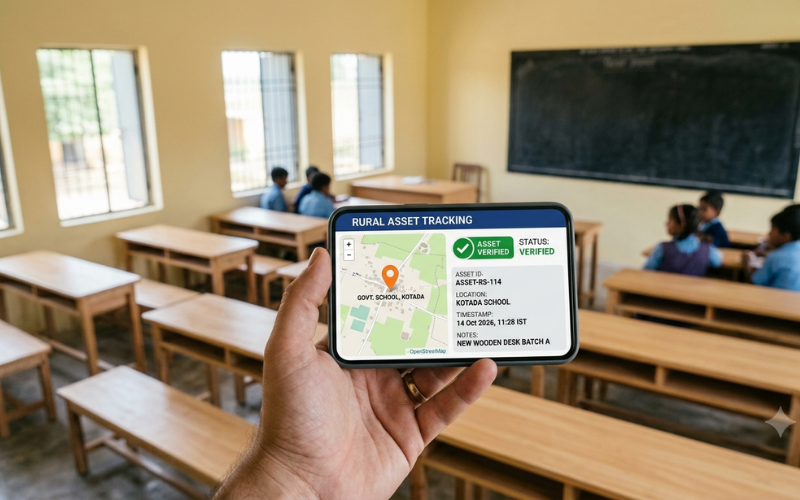
This is exactly the gap an online donation platform likeTrueGiv is trying to close, not by adding another scheme on top of the data above, but by making sure that when someone decides to donate money online, they can see exactly which school received what, backed by geotagged proof, rather than an administrative report that arrives months later.
A Simple Way to Check If Your Help Is Actually Making a Difference
Whether you choose to donate to rural education through TrueGiv or anywhere else, a few basic questions are worth asking before you fund a project:
- Can they show you the specific school? Not a general cause- an actual school, with a name and a physical location.
- Is there proof after the fact? A photo, a geotag, a report- something that shows the capital became a real physical asset, not just a transaction fee.
- Is the organisation registered and transparent about tax-saving donations Section 80G? This isn't just about getting your 80G tax receipt- it's a basic marker of financial accountability.
- Do they tell you what's still needed, not just what's already been done? Real transparency includes the gaps, not only the wins.
What Small, Verified Giving Can Actually Fix
It's tempting to look at numbers in the lakhs like 1.52 lakh schools without electricity, 98,592 without a working girls' toilet and feel like the problem is too large for any one donation to matter. That reaction is understandable, but it isn't quite accurate.
These national numbers are made up of individual schools, one at a time, each with a specific, fixable, physical gap. A missing set of desks in one school. A broken handwashing station in another. A blackboard that's been cracked for two years because no one in the local budget cycle had ₹2,000 spare to replace it.
None of these require a new policy or a new scheme. They require someone to notice, verify, and act, which is a very different, much more solvable problem than "fix Indian education."
This is also why verification matters as much as the donation itself. A desk that's paid for but never delivered doesn't help anyone. A toilet that's built but never maintained stops being functional within a year, which is exactly the pattern showing up again and again in the UDISE+ data above, schools that technically "have" a toilet, where a smaller number report it as actually working. Follow-up and proof aren't bureaucratic extras. They're the only way anyone can tell the difference between a rupee that reached a classroom and one that didn't.
What a School Day Actually Looks Like Without the Basics
It helps to slow down and picture one ordinary day, because the data above can start to feel abstract after a while.
A child walks to school in the morning, sometimes over an hour each way in a rural district. There's no drinking water source at the school, so she carries a bottle from home, and it runs out by the second half of the day.
There's a toilet block, but it hasn't worked properly in months, so she, like many girls her age, starts skipping school during certain days of the month rather than deal with it.
The classroom has forty children across two grade levels, because there's only one teacher for the whole primary section. The blackboard has a long crack down the middle, so half the class can't see what's written on that side.
None of this shows up as a single dramatic headline. It shows up as an attendance register with more absences than it should have, and a Class 5 exam result that doesn't reflect what a bright child in a better-equipped school two districts over could have achieved.
This is what "infrastructure gap" means in practice, not a missing building, but a hundred small frictions that add up to a child quietly falling behind, and no one single moment where anyone can point and say "this is where it went wrong."
This is also why fixing it doesn't require a dramatic solution. It requires the opposite. Someone paying close, boring, consistent attention to a hundred small things, one school at a time, and following up to make sure each one actually got fixed and stayed fixed.
The Bottom Line
India's school infrastructure story is genuinely two-sided. The national numbers show real, decade-long progress- more electricity, more toilets, more drinking water than ever before. But underneath those averages, lakhs of schools, and the children inside them, are still waiting for the basics.
Closing that gap isn't going to come from one government scheme, one corporate CSR budget, or one generation's attention alone. It's going to take all three, pointed in the same direction, with enough transparency that everyone involved can actually see the gap closing, one verified classroom at a time.
None of this needs to feel overwhelming. The scale of the problem is national, but the fix, every single time, is local: one school, one toilet, one desk, one child who now has what they need to simply stay in class through the day. That's a problem small enough for any individual donor or company looking for verified NGOs to support to actually make a dent in, as long as they can see, clearly, exactly where their part of it went.
FAQs
1.How does TrueGiv ensure my donation actually reaches the school?
We use an asset-tracking model. Instead of pooling unverified cash, we procure, deliver, and geotag exact physical infrastructure, such as desks, blackboards, and water filters, directly to verified schools.
2.Can individual donors and corporate CSR partners both use TrueGiv?
Yes. Individual donors can fund specific school wishlist items or contribute to our central corpus fund. Corporates can partner with us for transparent, audit-ready CSR project execution with clear proof of delivery.
3.Are donations made through TrueGiv eligible for tax benefits?
Yes. TrueGiv provides systematic Section 80G tax benefits, issuing unified annual tax certificates to make tax planning and compliance effortless for donors.
4.How are schools verified on the platform?
Our field teams verify every school request on the ground, checking baseline physical needs, student enrollment gaps, and institutional authenticity before any project goes live.

